Problem
Maintenance instructions are usually separated from the machine they describe. The prototype explores whether detected components and spatial guidance can be placed directly in the technician's field of view instead.
Research project · TU Dresden · 2024 - 2025
A projection-based maintenance prototype that detects machine components on a server and maps visual guidance back onto the physical workspace.
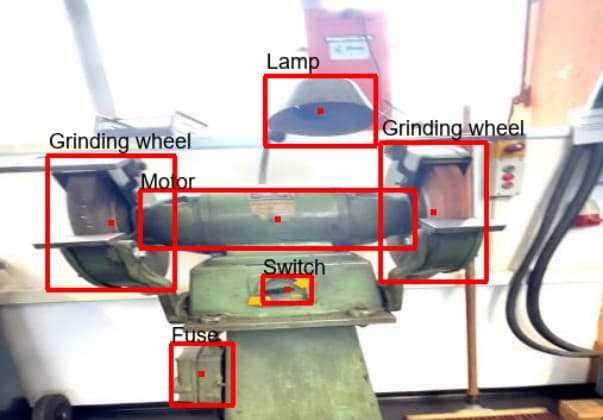
A distributed hardware-software prototype for industrial maintenance. A Raspberry Pi captures and validates camera frames, discovers the inference server on the local network, and projects returned component overlays. The Dockerized Flask backend runs a custom SSD detector and converts its output into spatial machine representations.
Maintenance instructions are usually separated from the machine they describe. The prototype explores whether detected components and spatial guidance can be placed directly in the technician's field of view instead.
Split the workload between a Raspberry Pi and a server. The edge device handles camera capture, brightness and blur checks, calibration, server discovery, and full-screen projection; the server exposes Flask endpoints for object detection and generates component-level overlay instructions.
Produced an end-to-end research prototype that connects edge hardware, containerized inference, spatial data generation, and projector output. The same pipeline later became the basis for research into automatically generated knowledge graphs from object detections.
A Python client-server system connected over the local network. The Raspberry Pi sends base64-encoded camera frames to a Flask API and receives detection coordinates as structured data. The server delegates inference to a Dockerized SSD model, derives spatial relations and overlay instructions, and returns them to the edge device for projection.
Fine-tuned SSD object detection on a custom dataset of industrial machine components.
Raspberry Pi camera capture, calibration, image-quality checks, and projector output.
Dockerized architecture for consistent deployment across edge and server environments.
Automatic discovery and health checks for the inference server on the local network.
Fine-tuned SSD object detection on a custom dataset of maintenance tasks.
Developed the Python backend for both the server and the edge device.
Added image validation, camera calibration, network-wide server scanning, and the projector-based AR overlay.
Extended the detection output with geometric spatial relations and multi-camera knowledge graph generation.