My thesis connects object detection with symbolic spatial reasoning. The generator turns bounding-box CSV data into OWL-compliant knowledge graphs, derives relations such as above, left of, and inside, and supports both single- and multi-camera inputs. I evaluated ten graph variants in OWL and plain triples across four language models.
Problem
Object detectors identify components and bounding boxes, but their output does not directly tell a maintenance assistant how those components relate to one another. Building that spatial knowledge layer by hand would be slow and tied to a specific machine.
Approach
Designed a deterministic pipeline that reads detected objects and pixel coordinates, derives spatial relations with geometric rules, and writes OWL ontologies with owlready2. For several camera views, it can either retain perspective-specific instances or summarize matching components into a smaller combined graph.
Outcome
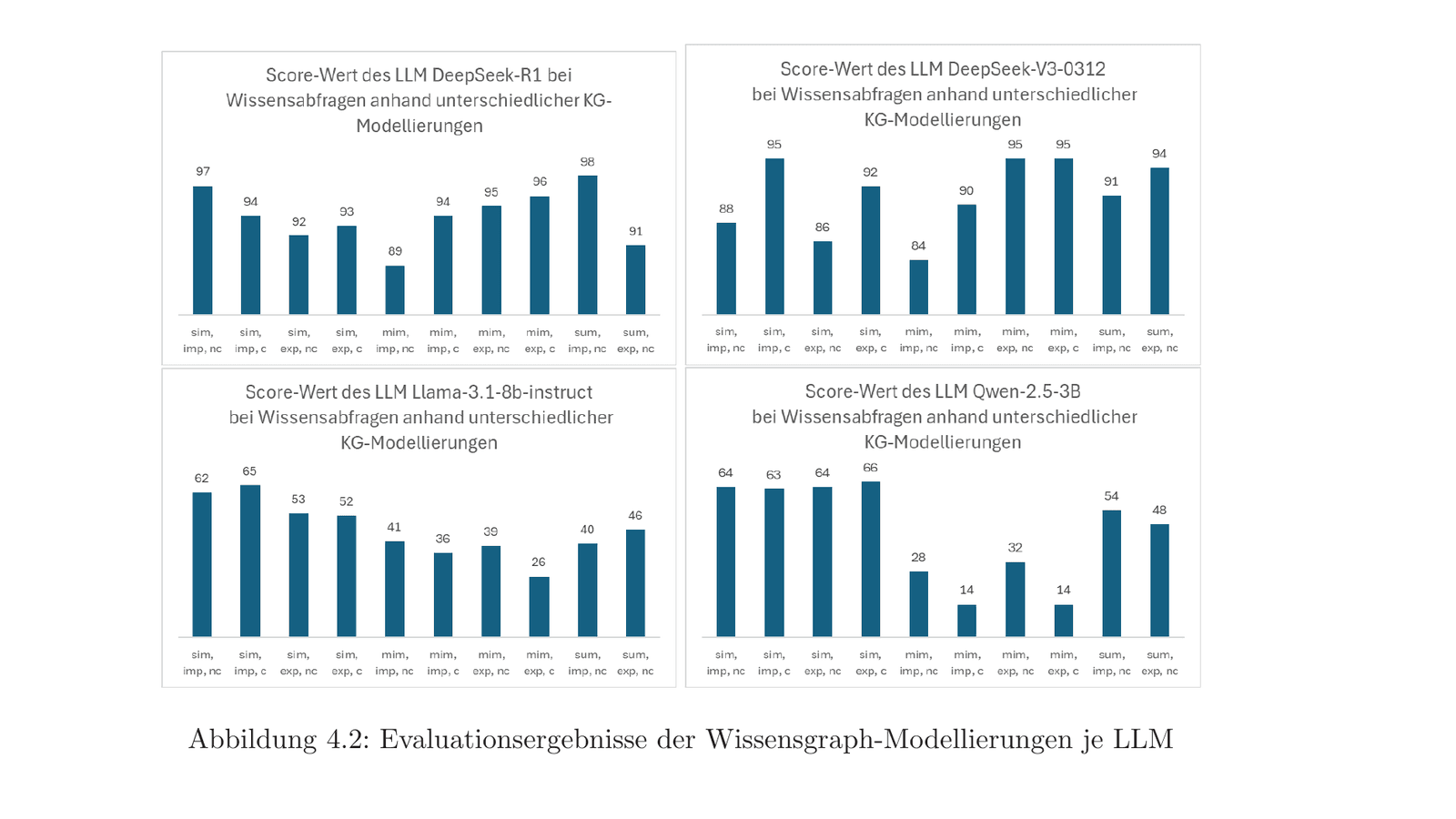
Generated and evaluated ten graph structures in two formats, producing 960 model answers across DeepSeek-R1, DeepSeek-V3, Llama 3.1 8B, and Qwen 2.5 3B. The results showed that graph complexity and serialization strongly affect smaller models; the thesis and defense received a grade of 1.4.
Architecture
The Python pipeline reads object-detection CSV files, calculates bounding-box centers, and applies threshold-based rules for vertical, horizontal, and containment relations. owlready2 serializes the result as OWL, while a statement generator produces a compact triple-text alternative. Both formats were tested across single-view, multi-view, and summarized graph variants.