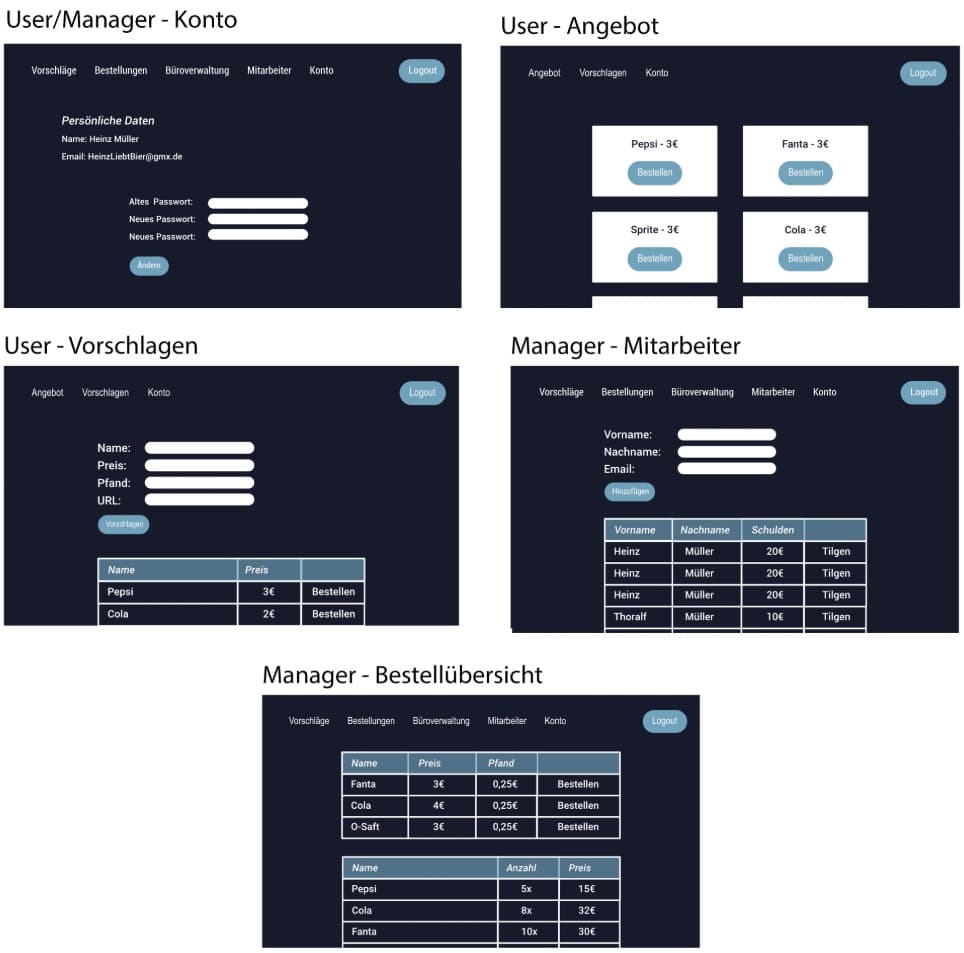
A university team project that replaced office drink lists and handwritten payment records with one web application. The system covers purchases, personal balances, stock, suggestions, orders, statistics, and user administration across employee, manager, and administrator roles.
Problem
The client managed office drinks with paper lists, which made purchases, outstanding balances, stock, and repeat orders difficult to track. The replacement had to stay quick enough for everyday use while separating employee, manager, and administrator permissions.
Approach
We built a Spring Boot and Salespoint application using Scrum. The backend separates shop, stock, suggestions, statistics, and user management into focused packages; Thymeleaf renders the interface, and Spring Security enforces role- and office-specific access.
Outcome
Delivered a working prototype and its supporting requirements, architecture diagrams, tests, and developer documentation. My work included implementation, unit testing, and design documentation within the shared codebase.
Architecture
A classic Spring Boot Model-View-Controller structure, with Spring Data JPA for object-relational mapping and Spring Security for granular access control across employee, manager, and administrator roles.