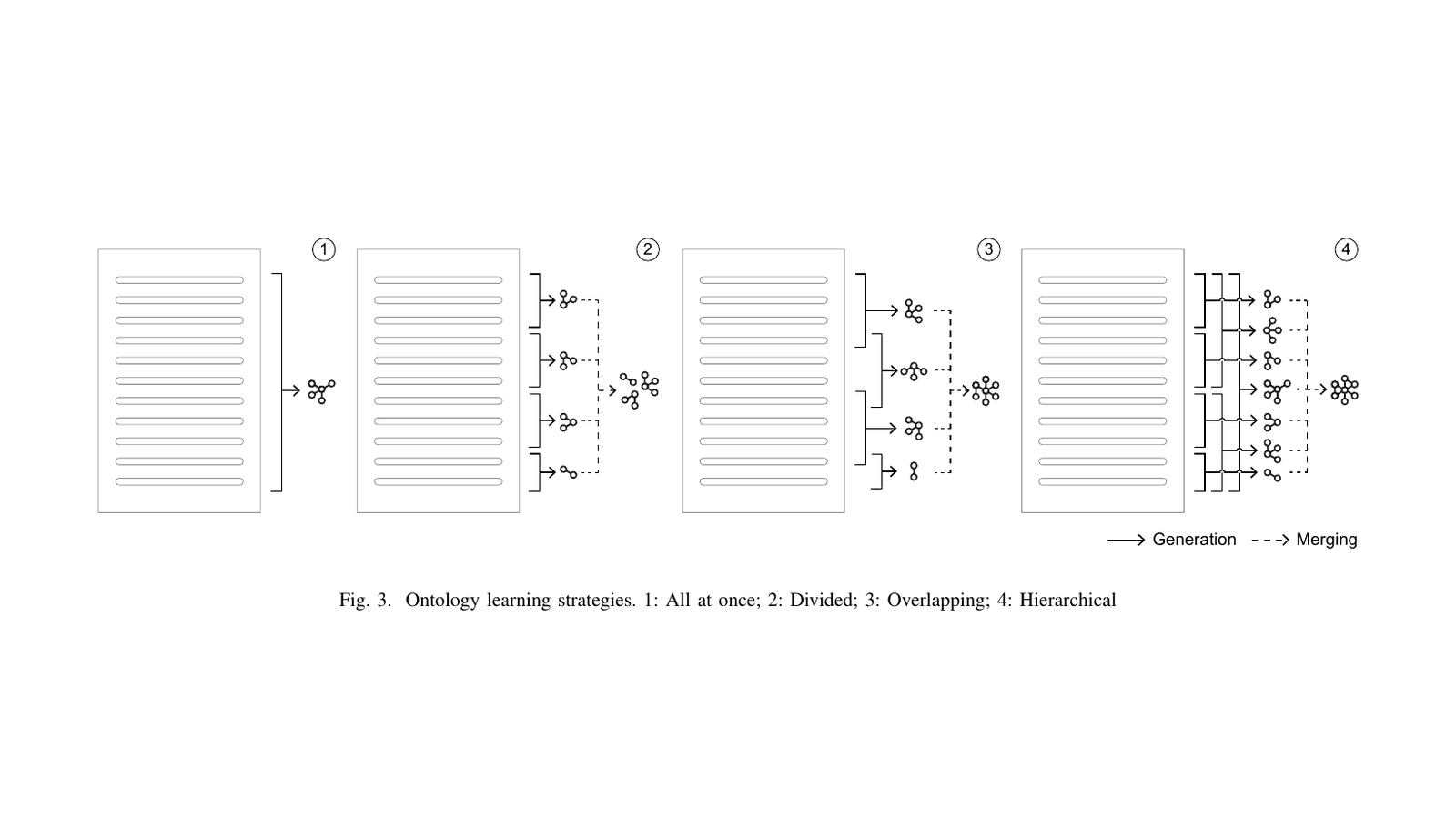
As part of an ongoing research paper at TU Dresden, I am developing a framework for extracting ontologies from long documents with large language models. The system splits source material into manageable sections, generates sub-ontologies in several formats, combines them with configurable merge strategies, and evaluates the result through deterministic checks and LLM-assisted review.
Problem
Industrial knowledge is often scattered across manuals, process descriptions, notes, and other documents. Modeling that information manually as an ontology is expensive, while processing an entire long document in one LLM prompt tends to lose detail and exceeds the practical context limits of smaller models.
Approach
Built a sentence-preserving chunking and generation pipeline that creates focused sub-ontologies in OWL, Turtle, JSON, or YAML. The fragments can then be combined through top-down, bottom-up, tree-based, or sequential merging, with optional overview ontologies and an improvement loop for repairing structural and semantic issues.
Outcome
The project provides a reproducible environment for comparing language models, serialization formats, chunk sizes, and merge strategies. The accompanying paper investigates how those choices affect syntactic validity, retained detail, semantic quality, and the usefulness of generated ontologies for industrial knowledge management.
Architecture
Python modules handle sentence-aware chunking, parallel LLM generation, format conversion, hierarchical merging, automated improvement, and benchmark orchestration. A Next.js dashboard provides visual configuration, live process output over Server-Sent Events, and an explorer for generated ontologies and evaluation reports.